

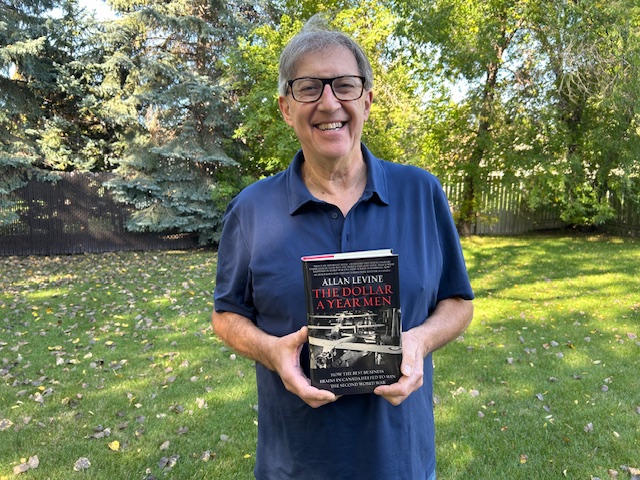
What was your goal while writing this book?
I knew very little about the dollar-a-year men, the Canadian businessmen who
volunteered or were recruited by C.D. Howe and other officials of the Mackenzie King
government during the Second World War to oversee the country’s wartime industry. It
was my publisher Sarah Scott of Barlow Books, whose grandfather, Douglas Ambridge
was one of these men, who introduced me more fully to the story. While there have
been many books published about Canada’s involvement in World War II, I learned that
there were only passing references to the dollar-a-year men and—with the exception of
a master’s thesis written in 2013—no book about them and their endeavours. With
Sarah’s encouragement, I delved into this fascinating story and knew immediately that it
had to be told. My main goal was to bring the history of these individuals and their
remarkable service to a wide audience, a story set against the larger narrative of
Canada during the war. How did a country, which in 1939 had a small navy, no real air
manufacturing and armaments production industries become in less than five years the fourth-largest industrial power in the world? That is what I set out to answer.
Was there a book or piece of writing that made you want to pursue writing as a career?
What was it?
Many (many) years ago when I was a graduate student at the University of Toronto, I
was inspired by the work of both academic historians such as J.M.S. Careless, who
served as my adviser on my doctoral dissertation, and Michael Bliss, as well as by
popular historians such as Pierre Berton and Peter C. Newman, who I worked closely
with in researching his trilogy on the history of the Hudson’s Bay Company, the first of
several book projects that I assisted him with. I was determined that like both the
academics and the popular writers, I could write history that was based on solid
research, yet written in an engaging style that attracted many readers. That objective
has guided my writing career for the past four decades. Hence, my models were such
books as the two-volume biography, George Brown of the Globe by Prof. Careless; The
Discovery of Insulin by Michael Bliss; The National Dream and The Last Spike, Pierre
Berton’s two volume history of the CPR; and Renegade in Power about the rise and fall of John Diefenbaker and the three-volume history of the HBC by Peter C. Newman.
Why is writing about Canada/Canadians important to you?
We live in a complicated world, one in which Canada—its history, culture and society—
often has been overshadowed by the United States. My interest in Canada dates back
to high school and the Canadian history course I took in Grade 11. That piqued my
interest and convinced me that the country’s history, its people and events over many
centuries, was significant and stood on its own. My studies after that at university and
beyond have only strengthened that view. Recently, as the country has faced economic
pressures and even threats from certain American politicians, it is even more essential
that Canadians continue to research and write about their own history, good and bad, to
fully understand our place in the world now and in the future.